Building Agentic AI Systems
A practical path from why agents matter to building your first multi-agent pipeline: the landscape, the key design decisions, and the hands-on build.
The lessons
- 1
Part 1 · 7 min
The Agent Revolution Is Here, and Most Organizations Are Not Ready
Gartner says 40%+ of agentic AI projects will be cancelled by 2027, and only ~130 of thousands of "agentic" vendors are real. Here's what the research actually shows, and what separates the teams shipping from the ones stuck in pilot purgatory.
- 2
Part 2 · 7 min
State of Coding Agents: Who Actually Wins on Real-World Tasks?
Agents score 90%+ on SWE-bench. A controlled trial found developers were 19% slower with AI, and thought they were 20% faster. Why both are true.
- 3
Part 3 · 8 min
RAG vs. Fine-Tuning: A 2026 Decision Framework for Practitioners
Stop arguing. Here's a decision tree grounded in cost, latency, and drift.
- 4
Part 4 · 6 min
Building Multi-Agent Pipelines with LangGraph: A Practical Guide
LangChain now recommends the tool-based supervisor over create_supervisor. Here's the pattern to build, the three context decisions that decide if it works, and published benchmarks on which architecture actually costs less.
- 5
Part 5 · 7 min
LangGraph vs AutoGen vs CrewAI: The 2026 Comparison Is Already Out of Date
The popular three-way comparison is stale: AutoGen is now maintenance-only, folded into the Microsoft Agent Framework (1.0, April 2026). The real live choice is LangGraph vs CrewAI, and the honest first question is whether you need a framework at all.
- 6
Part 6 · 6 min
Agent Accuracy Went Up. Agent Reliability Barely Moved.
Twelve metrics, four dimensions, 14 agentic models. The finding: reliability gains lag well behind capability gains. Why a single success rate hides the flaws that actually break deployments.
- 7
Part 7 · 10 min
Switching Agent Harnesses Changed 13% of Tasks. Rerunning the Same One Changed 13% Too
Five models, three production harnesses, 447 real GitHub issues. Claude Code and mini-SWE-agent land within five points of each other, a harness swap flips as many tasks as a rerun, and cost per task differs up to 3x. The wrapper decides the bill, not the score.
- 8
Part 8 · 14 min
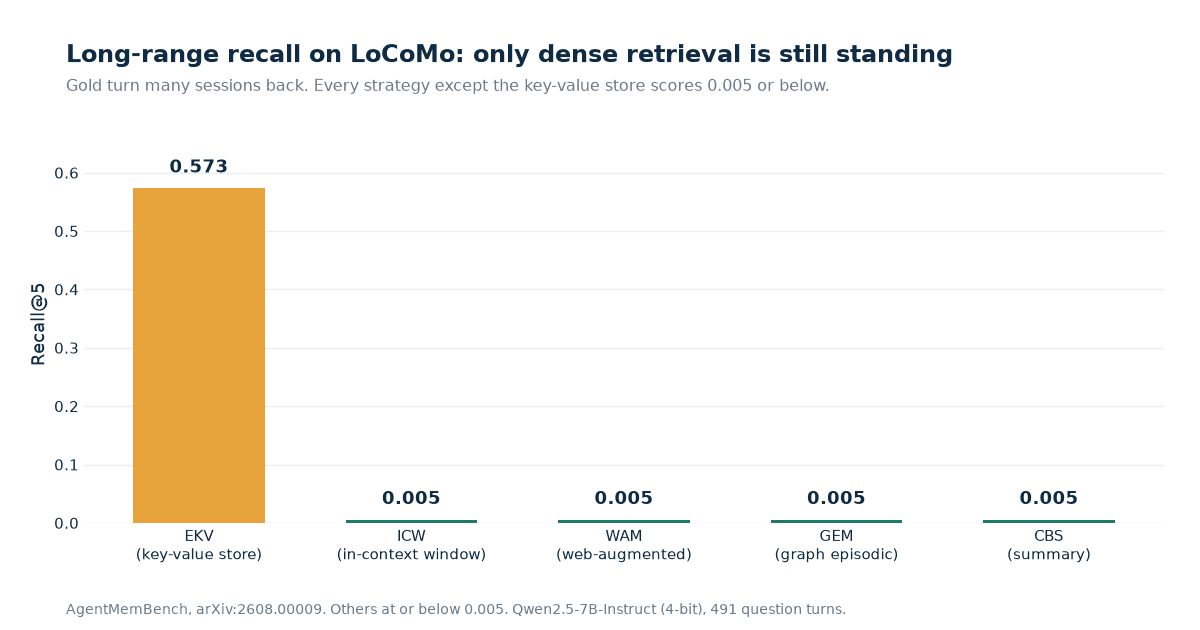
Agent Memory Is Three Systems, Not One. Five Papers Prove the Split
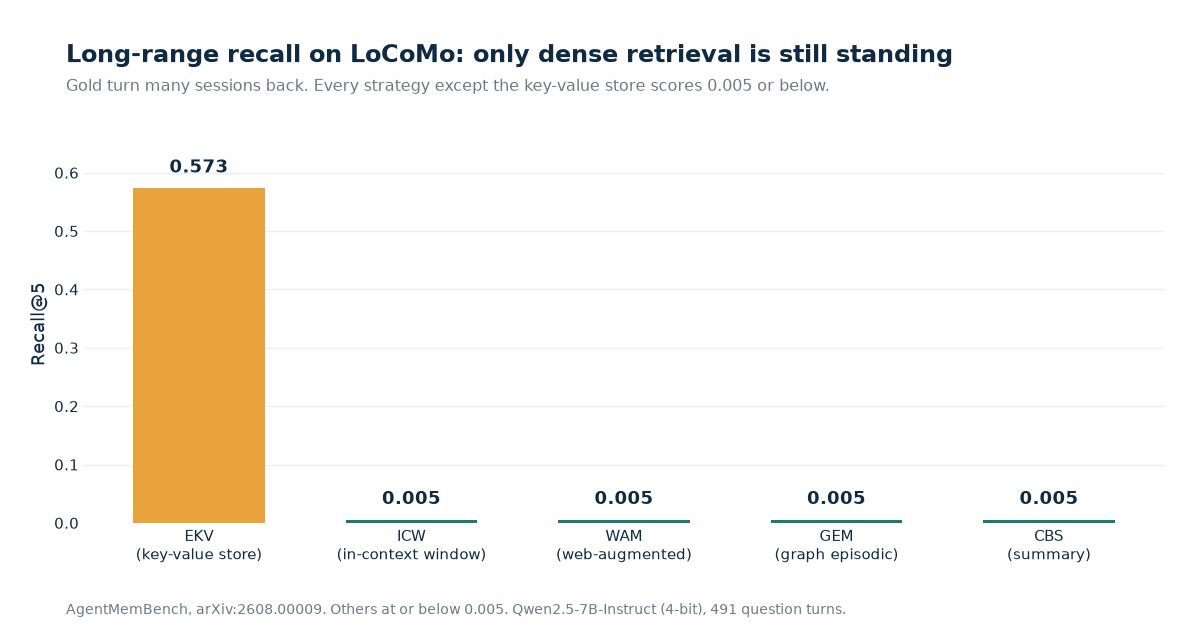
Five papers split agent memory into three jobs: factual recall, behavioural rules, and the cost of remembering. Dense retrieval wins long horizons, compaction beats raw transcripts until wording matters, and corrections need rules, not search.
- 9
Part 9 · 7 min
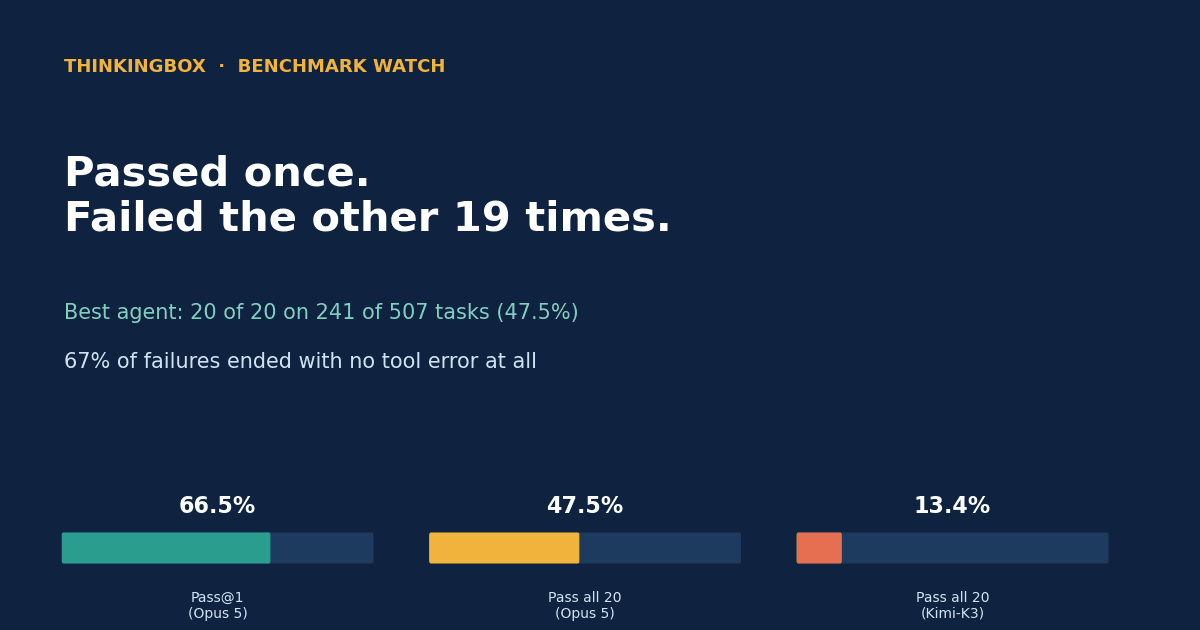
Passed Once Is Not Reliable: ThinkingBox Grades Agents on the Database, Not the Demo
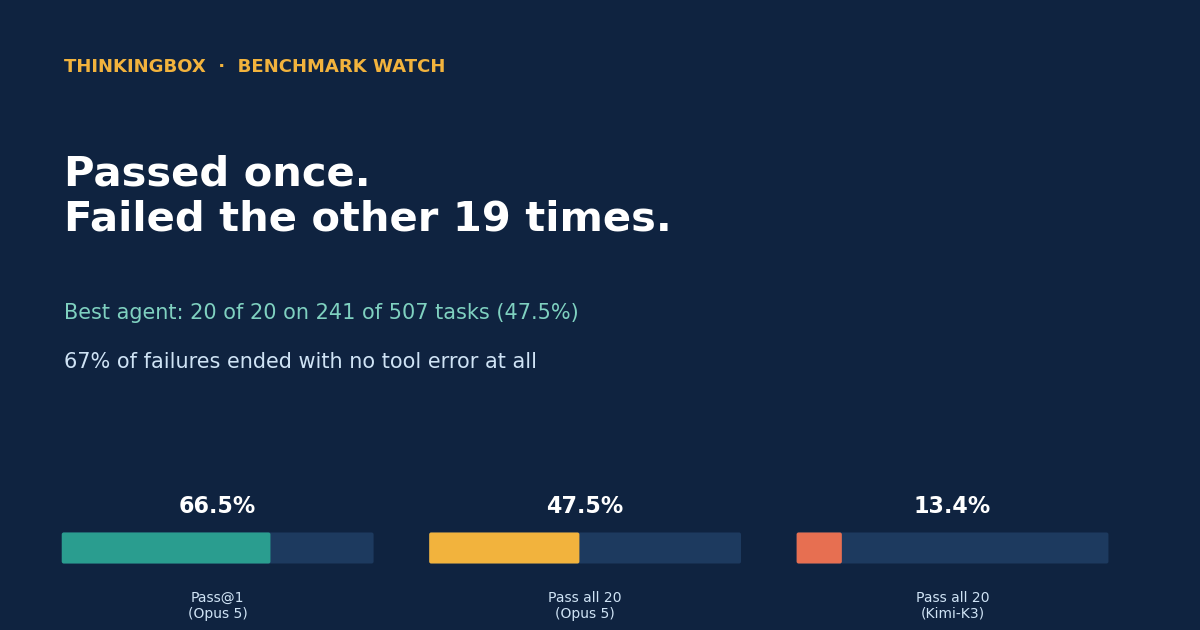
ThinkingBox checks the final database state after an agent finishes, not its summary. Across 121,680 trials, 79,853 failed, and 67% of failures ended with no tool error. One good demo is not reliability.
- 10
Part 10 · 11 min
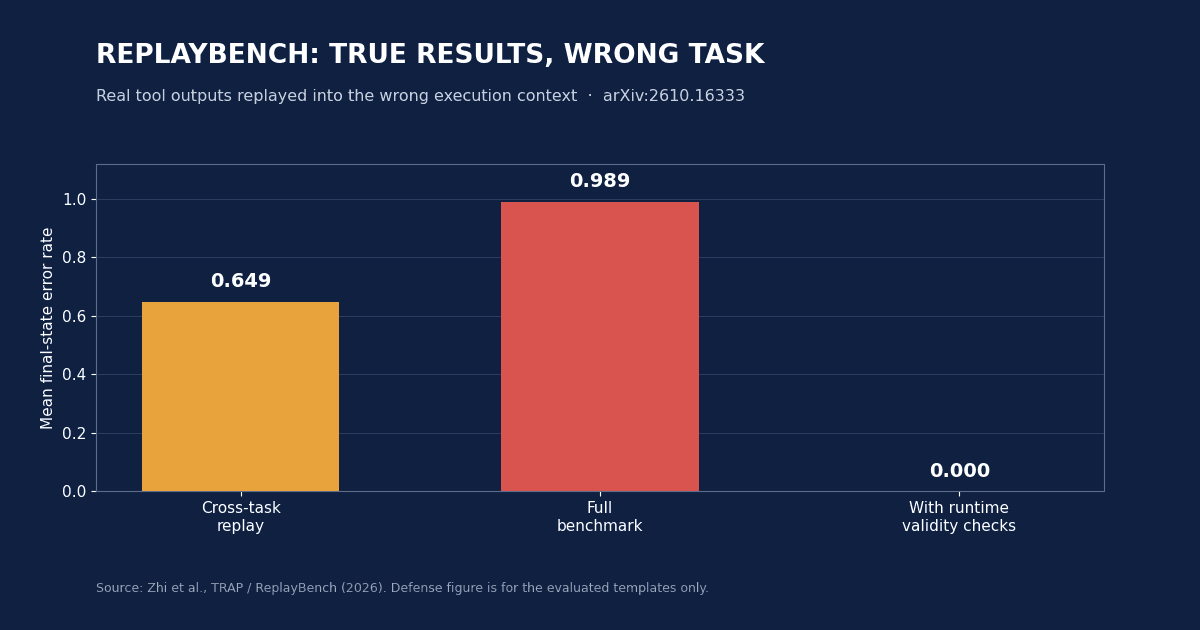
A True Tool Result Can Still Be Wrong: ReplayBench Found a 64.9% Error Rate
TRAP replayed real, unmodified tool results into the wrong task. Agents acted on them anyway: mean final-state error 0.649, and 0.989 across the full benchmark.